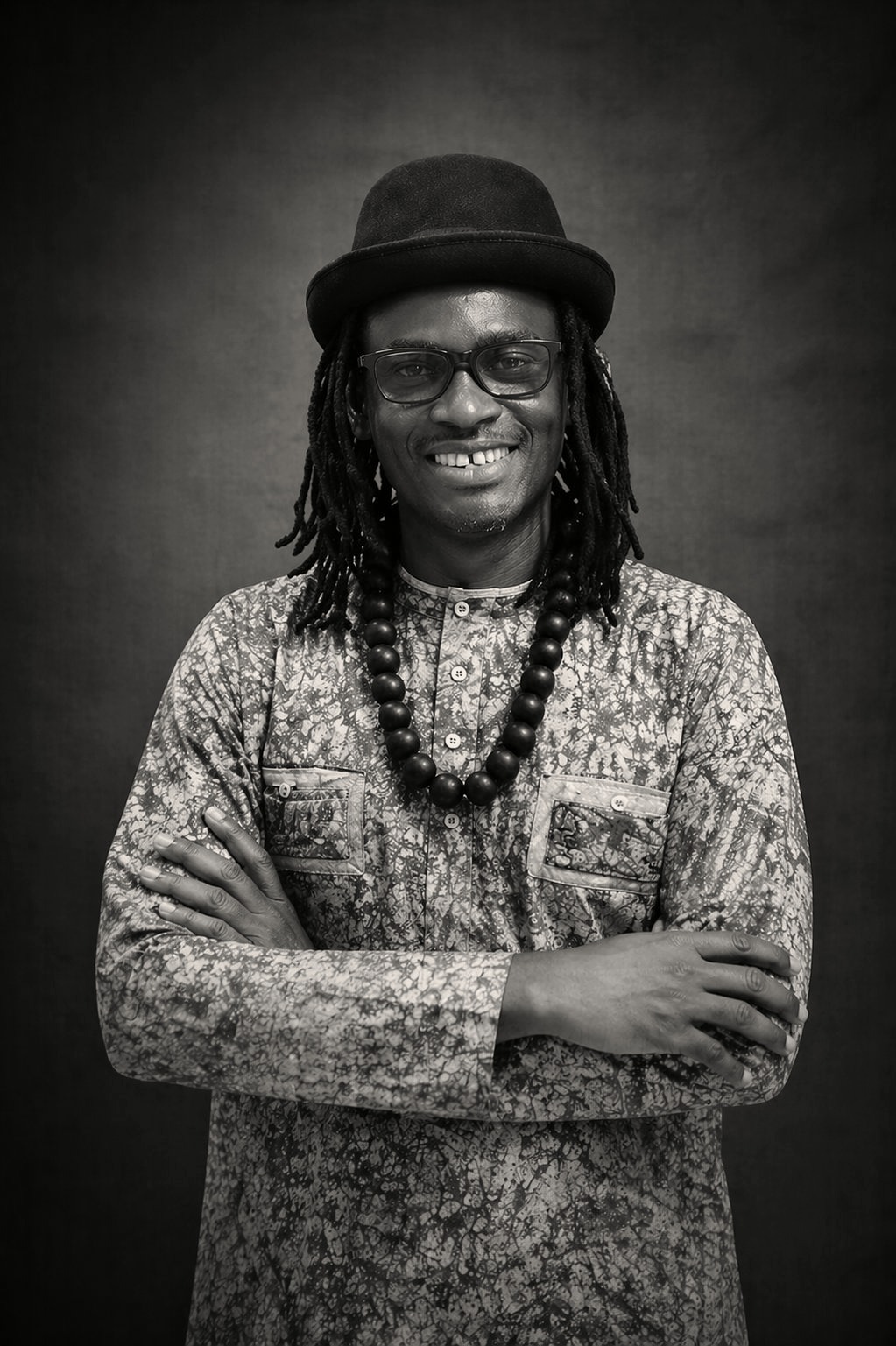
Artist & Designer · Studio SHO
Multidisciplinary Artist & Designer · Burkina Faso
"This material reflects the economic dependency of the country and its relationship with the rest of the world. By integrating it into my creations, I elevate it — give it a more noble life."

Hamed Ouattara · Studio SHO · Ouagadougou
Permanent Collections
Hamed Ouattara (b. 1971, Ouagadougou, Burkina Faso) is a multidisciplinary artist and designer whose practice centres on the transformation of discarded industrial oil drums into sculptural furniture of singular formal intelligence. Trained at ENSCI – Les Ateliers, Paris (diploma 2003), Ouattara returned to West Africa to found Studio SHO in Ouagadougou in 2002, establishing a production model rooted in the compagnonnage tradition — a collective apprenticeship through which knowledge is transmitted from master to practitioner across generations.
His objects draw explicitly from the geometric vocabulary of Sudano-Sahelian architecture: the flat-roofed mud-brick compounds, the tapering buttresses, the repeating triangular corbels of mosques from Djenné to Bobo-Dioulasso. Ouattara reads the oil drum — ubiquitous throughout sub-Saharan Africa as a vessel of petroleum dependency — as a material charged with geopolitical meaning. By reworking it into furniture that occupies museums and private collections, he proposes an act of reclamation: turning the emblem of extraction into an object of cultural sovereignty.
The formal language Ouattara deploys has been described as Afrofuturist, though he resists easy categorisation. His cabinets, chairs and stools operate simultaneously as sculpture, as functional object, and as archive — each surface pattern referencing a specific cultural or architectural source, each title anchoring the work to a specific place, community or memory within Burkina Faso.
Ouattara's work is held in the permanent collections of the Brooklyn Museum (New York), the Denver Art Museum, the Vitra Design Museum (Weil am Rhein), the Centre Pompidou (Paris), and the V&A Museum (London). He is exclusively represented internationally by Friedman Benda Gallery, New York, where his solo exhibition Bolibana was presented in 2023.
Chronology
1971
Born in Ouagadougou, Burkina Faso
2002
Founded Studio SHO in Ouagadougou
2003
Diploma, ENSCI – Les Ateliers, Paris
2014
Africa Design Award, Johannesburg
2014
Chevalier de l'Ordre du mérite des Arts, Burkina Faso
2023
Acquisition, Denver Art Museum
2023
Acquisition, Brooklyn Museum (Acc. 2023.66)
2023
Bolibana — Friedman Benda Gallery, New York
2026
COME BACK — Musée National du Burkina Faso, Ouagadougou
2026
Homo Faber — Fondazione Giorgio Cini, Venice
The Atelier
Studio SHO operates on a compagnonnage model — a form of craft transmission rooted in the French guild tradition — adapted to the context of Ouagadougou. Each of the fifteen artisans who make up the studio is both practitioner and student, mastering the full production chain of an object from raw material to finished piece.
All tools used in the studio are fabricated in-house, reinforcing a philosophy of sovereign production: the studio does not depend on imported equipment, industrial supply chains, or external finishing processes. Every decision, from the sourcing of reclaimed oil drums to the final application of powder coat, remains within the control of the collective.
This model produces objects of extraordinary precision and consistency — but also ensures that knowledge remains embedded in Ouagadougou, building technical capacity that outlasts any single commission or exhibition cycle.
15+
Artisans
20+
Years
5
Museum Collections
100+
Works Created
Future Vision
Sira Arta is the long-horizon vision of Hamed Ouattara and Studio SHO: a 17-hectare cultural campus on the Route de Bobo-Dioulasso, conceived as a living infrastructure for design, craft, education, and artistic production in Burkina Faso.
The project is developed in partnership with ROUN-SA and Harouna Kanazoé, with architecture conceived by the practice Moyésoa, led by William Tailly of ESA Paris. The campus will integrate residential studios, production workshops, exhibition space, a resource library, and accommodation for artists in residence — all designed in dialogue with vernacular Sahelian construction methods.
At its core, Sira Arta is a bet on sovereignty: the conviction that world-class artistic production can originate from Burkina Faso on its own terms, without migrating to European capitals. It extends the compagnonnage model of Studio SHO to a continental scale, offering a dedicated infrastructure to the next generation of West African designers and craftspeople.